Showing posts with label GMoAT?. Show all posts

Saturday, January 11, 2014

Movie Review: On the Waterfront


Finally, it's what you've been waiting 60 years for: my review of On the Waterfront. As a refresher, this is part of my Greatest Movies of All Time? personal challenge, where I made a list of the hundreds of greatest movies made using a combination of American Film Institute lists and Academy Award results. A lot of them, especially the classics, I had never gotten around to seeing and this was my excuse to do so. Plus, there's my OCD and if something comes in a list form, so help me, God, I'm there.

On the Waterfront was ranked No. 3, behind Casablanca and Gone with the Wind.

Basically, the plot follows Terry Malloy (Marlon Brando), a dockworker on the waterfront run by mobster Johnny Friendly (Lee J. Cobb). In a previous life, Malloy had been a prizefighter, but at the urging of his brother Charley (Rod Steiger), who also happens to be Friendly's right-hand man, he threw the fight and pretty much threw away his career.

As the movie begins, Malloy is drawing out fellow dockworker Joey Doyle, thinking that Friendly's goons would put a scare in the soon-to-be informant. Instead, they kill him. Malloy's not super happy that he was used as a pawn to kill someone, but such is life on the docks. He soon befriends/dates Joey's sister Edie (Eva Marie Saint), who makes it her goal to figure out what happened to her brother, with the help of the local priest, Father Barry (Karl Malden). Father Barry tries to get the dockworkers to stand up to Friendly and work with the police, but the one guy he convinces soon has a case of whiskey dropped on his head. Those slippery ropes!

Edie and Father Barry set their sights on Malloy as someone to testify and his conscience starts tormenting him. Which makes Friendly's men, including Charley, torment him.

The movie is an entertaining one regardless of context, but when viewed in the era of organized crime and sketchy unions (the story is based on a Pulitzer Prize-winning newspaper series about a real Mob-run waterfront in New York). The acting is obviously stellar, too, with Brando at his best.

But you don't need me to tell you that. Here are its bonafides, which is what led to its inclusion on the GMoAT? list:
  • Won the Academy Award for Best Picture
  • Brando won the Academy Award for Best Actor
  • Saint won the Academy Award for Best Supporting Actress
  • Ranked No. 8 in the AFI list of 100 Greatest Movies in 1998 (and No. 19 10 years later)
  • Ranked No. 36 in the AFI list of the Most Inspiring Movies
  • Had the No. 3 Most Memorable Quote, according to AFI, for Malloy's "You don't understand! I coulda had class. I coulda been a contender. I coulda been somebody, instead of a bum, which is what I am" speech.

Monday, August 12, 2013

Movie Review: Gone with the Wind


Gone with the Wind is kind of like Casablanca with me. I know it's considered one of the biggest classic movies in the history of movies, but other than the fact that it has something to do with the Civil War and includes the line, "Frankly, my dear, I don't give a damn," I really knew nothing about it. Unlike Casablanca, I was less than thrilled.

For other modern-day movie morons, I'll give you as brief a rundown as possible with a 4-hour-plus movie. (Seriously. Four hours. Plus. Especially if you actually sit through the 75 musical interludes.) When we first meet Scarlett O'Hara, she's the prettiest and most sought-after young thing in her Georgia town. The oldest daughter in her rich, plantation-owning family, she has pretty much every guy she meets wrapped around her finger. Well, every guy except the guy she loves: Ashley Wilkes, the son of another rich plantation owner in town. She dolls herself up for a party at the Wilkes' place, hoping to lure Ashley  into her clutches, until she realizes that the whole point of the party is to announce Ashley's engagement to his cousin, Melanie Hamilton. (Apparently, marrying cousins is big in the Wilkes family. Ashley's sister wants to marry Melanie's brother, too. It's possible this whole thing takes place in Shelbyville.)

Scarlett declares her love to Ashley but he really does love Melanie. So she does the next best thing: marries Melanie's brother Charles out of spite, to make Ashley jealous while also keeping the whole Wilkes family close by. About five seconds later, the Civil War begins, Melanie & Ashley and Scarlett & Charles marry within a couple days and a couple days after THAT, the boys are off to fight.

It doesn't take long for Charles to become a non-violent war casualty, dying of pneumonia and leaving Scarlett a very young and not very mournful widow. She decides to move to Atlanta to stay with Melanie to "help with the war efforts," which really means "know as soon as possible what's going on with Ashley and then try to steal him from her." The two women devote their time to helping care for injured soldiers, etc. When Ashley gets a few days' leave around Christmas to visit, he spends his time doting on Melanie, trying to ignore Scarlett and also getting Melanie pregnant. Before he leaves, he asks Scarlett to take care of Melanie.

It's a bigger promise than Scarlett realizes when Melanie has a difficult pregnancy and gives birth right around the same time as Sherman's invasion of Atlanta. Scarlett and her simple-minded servant (slave?) are stuck delivering the baby and then trying to get to the O'Hara plantation - named Tara - in order to keep them safe and also to check on Scarlett's own sick mother. She calls the only person she can think of: Rhett Butler.

Until this point, Rhett has been kind of like that annoying fly that keeps showing up. We meet him at the Wilkes' party, where he annoys everyone by saying the North would win any war with the South. He overhears Scarlett's declarations of love to Ashley and then teases her about it. But he's an able-bodied man with lots of connections and he gets her a horse and carriage to take Melanie and her baby away. Along the trip, both Scarlett and Rhett grow up a little bit when they see their wounded soldiers march by, and Rhett is motivated to jump out of the carriage right then and sign up to fight. Why? I have no earthly idea. Scarlett continues the journey, learning along the way that the Wilkes plantation has been burned to the ground by those evil Yankees.

Tara is still standing, but barely. The barn is gone, the livestock is gone, all but two of the "servants" are gone, her mother is dead of typhoid, her two sisters are both sick with the same disease (although recovering) and the stress has driven her father to mental instability (something the actor - Thomas Mitchell - is pretty adept at, since he also played Uncle Billy in It's a Wonderful Life). Scarlett becomes the de facto head of the household, trying to keep everyone fed and afloat.

Then the war ends and the South lost. And the government puts a heavy tax on Tara that Scarlett can't afford. Her father is so overcome with rage that he starts chasing after a prospective buyer and dies falling off his horse. Scarlett finds Rhett in Atlanta and tries to flirt the money out of him, but he sees through her and refuses. She runs into Frank Kennedy, her sister's fiance, who is trying to run an antiques store and lumber mill in order to raise enough money for the wedding. Seeing how high his prospects are, Scarlett tells him her sister is marrying someone else and goads him into marrying her instead.

Scarlett's business acumen (she and Frank join forces with Ashley Wilkes) leads to a thriving lumber mill, but that doesn't stop her from almost being raped in the middle of the woods. Frank, Ashley and a gang of vigilantes goes out to get revenge - Rhett tries to save them but is too late as Frank dies and Ashley gets shot in the arm. So now Scarlett's a widow twice removed.

Rhett takes the opportunity of her husband dying, oh, 12 minutes before, to propose and convince her to marry him. She agrees and they travel around in the lap of luxury. But when they return home, Scarlett goes back into her Ashley-obsessed ways. She gives birth to her and Rhett's daughter, who Rhett adores, but the couple is distant and aiming for divorce. Also, there's a lot of drinking and marital rape, so that's fun.

I'm almost to the end so I'll stop there. I've spared you about 12 more character deaths. Moral of the story? Stay away from Scarlett O'Hara. Nothing good can come from this.

I had a problem getting into and enjoying this movie, which probably makes me a bad movie fan, but oh well. First of all, with the exception of the good-hearted Melanie, every character was despicable. Scarlett and Rhett were both selfish and conniving and manipulative and cold-blooded. Ashley (and Scarlett's parade of dead husbands) were clueless. I wasn't rooting for Scarlett to get Ashley or Rhett to get Scarlett; I wanted Melanie to win and Mamie to raise up the other servants and say, "Hey, you guys enslaved us for years and you can't buy me back with a red petticoat. I'm going north, suckas!" I had a hard time sympathizing with these Southern rich slave owners during the Civil War, too, their English acting accents be damned. Yes, it's sad that people died and their lives were difficult, but then...they were slave owners. They'd been making their slaves' lives pretty difficult for a few decades.

Anyway, Gone with the Wind was ranked No. 2 on my arguable Greatest Movie of All Time List. Here's why:

  • Oscar winner for Best Picture in 1939 (also won for Best Director, Best Adapted Screenplay and a slew of cinematography awards that I didn't count but are worth mentioning).
  • No. 4 ranking in the American Film Institute's 100 Years, 100 Greatest Movies list in 1998.
  • Held on for a No. 6 ranking 10 years later.
  • No. 43 in AFI's 100 Years, 100 Cheers.
  • Had three of AFI's most memorable quotes, including No. 1:
    • "Frankly, my dear, I don't give a damn." (1)
    • "After all, tomorrow is another day!" (31)
    • "As God is my witness, I'll never be hungry again!" (59)
  • Oscar win for Best Actress for Vivian Leigh. (Hattie McDaniel became the first African-American to win Best Supporting Actress for playing Mamie, while Clark Gable (Rhett) and Olivia de Havilland (Melanie) were nominated for Best Actor and Best Supporting Actress, respectively.)

Monday, July 22, 2013

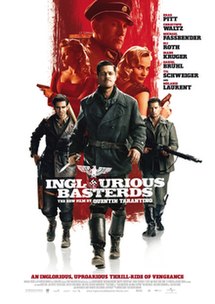
Movie Review: Inglorious Basterds


I never really thought of myself as a Quentin Tarantino fan and still don't, for the most part. I appreciated Pulp Fiction as a good movie but wasn't really my thing and stuff like Kill Bill et al. just never appealed to me. Things changed with Django Unchained, a really good story with awesome acting that, despite its gratuitous violence, didn't really turn into a "Tarantino movie" until the very end when (SPOILER ALERT) an entire plantation's worth of people get their innards splattered against the wall.

Because of how much I liked that movie, I thought I'd give Tarantino's other recently critically acclaimed movie a shot. Plus, Christoph Waltz. I mean, c'mon.

Inglorious Basterds is the historically fictitious story of two separate plots to assassinate Adolf Hitler and a slew of other Nazi leaders at the exact same time. One of the plots comes from Shoshanna (Melanie Laurent), a young French Jewish woman whose family is shot by the vicious Nazi officer Hans Landa (Waltz) while trying to hide in a neighbor's floorboards. That scene tells you a lot about Shoshanna's fighting spirit and tragic tale but even more about Landa, equal parts brilliant and pure evil.

A few years after her escape, Shoshanna is living as Emmanuelle Mimieux, a cinema owner in Paris. She inadvertently catches the eye of Fredrick Zoller, whose recent heroics (the Nazi sniper killed hundreds of enemy soldiers while holed up by himself for three days in a bird's nest) are being turned into a Nazi propaganda film by Hitler's second-in-command Joseph Goebbels. In order to impress his new ladyfriend, Zoller convinces Goebbels to hold the film's premiere in her theater, much to her chagrin. But after she realizes that her theater will be full of Nazis, including Landa, she plots a way to burn the whole building down with them inside.

Meanwhile, the Basterds, a group of Jewish-American soldiers (with a couple of anti-Nazi Germans thrown in) headed by Lt. Aldo Raine (Brad Pitt), also hear of the premiere. This group is dedicated to killing Nazis in the most Tarantino-esque ways possible. In one 10-minute stretch, we see scalpings, throat-cuttings, and a guy get bludgeoned to death with a baseball bat. Raine's plan for the premiere is similar to Shoshanna's - all of Germany's worst baddies in the same small space is too good to turn down.

I won't ruin the end, but suffice to say that my attempt to keep a tally of on-screen deaths was futile when I was no longer able to keep the numbers straight.

Like Django, the movie had a vigilante justice theme with the least sympathetic villains ever. (Seriously, Nazis? Slave owners? I'm curious who Tarantino has left in his Most Hated People Ever drawer.) But while we had our obvious heroes in Django and King Schultz, the heroes in Inglorious Basterds are a little different, if only because there were almost too many of them. The two different plots were hard to keep track of, and even more so considering more than half the movie was in subtitles. One scene that takes place in a German bar had such weird lighting that it was almost impossible to read the yellow words. I found myself so focused on not missing what they were saying that I completely forgot who was talking at all.

This makes me sound like a simple American and that's probably true. I don't love subtitles for this reason. I doubly don't love subtitles when watching at home (I'm sure it was easier to read this stuff on a big movie screen). Oh well.

In the end, Inglorious Basterds leaned more toward Pulp Fiction than Django Unchained in my Tarantino Spectrum. I could appreciate the quality of the film, the intricacies of the plot, and the fantastic acting of Christoph Waltz, who is seriously just awesome. But I wouldn't say I loved it and I can't say I'd want to see it again.

Greatest Movies of All Time? Inglorious Basterds ranked in at No. 267, spurred by its Best Picture nomination. (Waltz won for Best Supporting Actor, although that didn't come into consideration for the GMoAT list.)

Monday, June 24, 2013

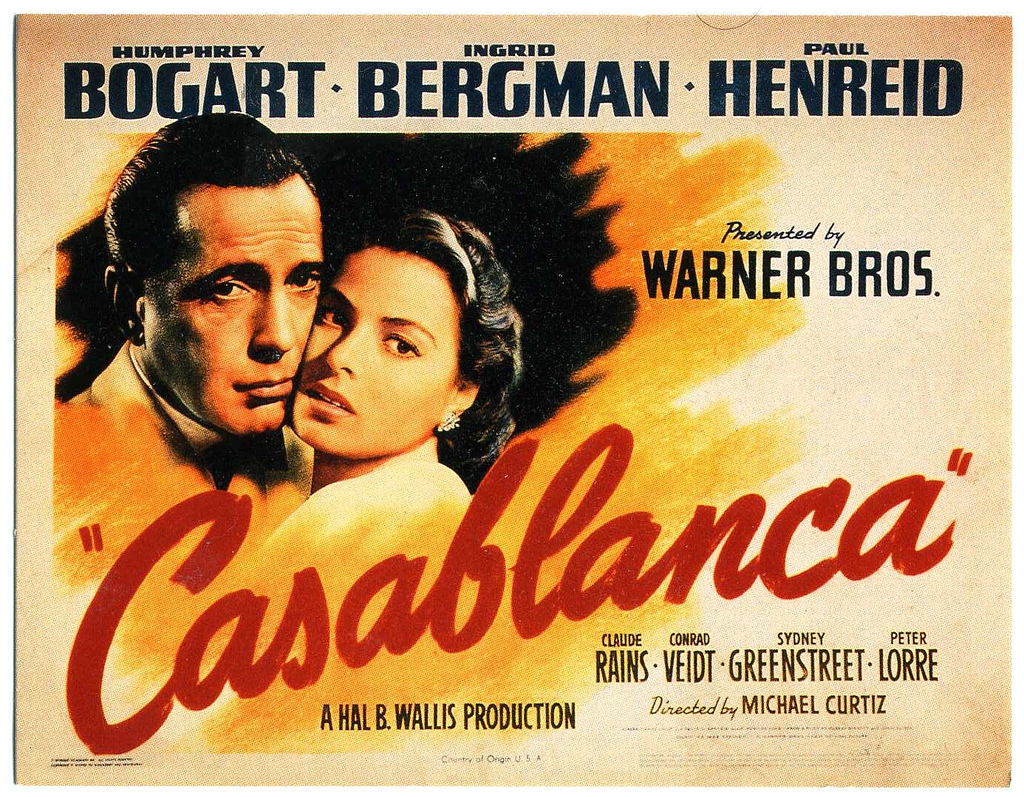
Movie Review: Casablanca


I know, right? Like you need me telling you about Casablanca. The movie is older than your grandparents. Only dopes like me have gone this far in life without actually seeing it.

Well, LAY OFF, OK?!

Sorry. Anyway, yes, it did take me more than 28 years to see the movie that is universally beloved and wound up as No. 1 on my Greatest Movies of All Time? list. Not only that, but unlike a lot of "You've never seen THAT?" movies, I didn't even know what it was really about. I mean, I know Darth Vader is Luke and Leah's father, I know Rosebud is a sled, and until a few months ago, I knew a bloody Rocky would go all "yo, Adrian" from the middle of a boxing ring. But I didn't even know what Casablanca was about. I'm a terrible member of society.

For anyone else who has been living under a rock for the past 71 years, let me sum up. Casablanca is a town in French Moracco and during World War II (post-Paris invasion, pre-Pearl Harbor), served as kind of the docking station for people trying to escape Nazi-occupied France. Except a lot of people got as far as Casablanca before getting stalled due to a lack of transmit papers to get them to the U.S. or wherever.

Rick (Humphrey Bogart) is an American who owns Rick's Cafe Americain, part restaurant, part bar, part night club, part casino. At the beginning of the film, Rick comes into possession of a pair of transmit papers that will allow two people to escape the war zone. Around the same time, Major Strasser shows up looking for a Czechoslovakian revolutionary named Victor Laszlo, who has spent time in multiple concentration camps while devoting his life to fighting Nazis.

Laszlo also shows up, joined by his wife Ilsa (Ingrid Bergman). Ilsa just happens to be Rick's ex-girlfriend; the two had a fling and meant to escape together when the Nazis invaded Paris but she ditched him without explanation. Let's just say Rick's a little bitter.

The rest of the film is spent learning just what type of guy Rick is - is he the gruff loner he portends or does he have a heart of gold underneath? - as well as what, exactly, Ilsa's problem was all those years ago (hint: she has a pretty good excuse). What will become of Laszlo, not to mention Rick's secret transmit papers?

Casablanca was impressive for a lot of reasons but the one that stuck out to me was its scope. So many movies and TV shows from that time period are centered around white WASPy guys. And while Rick certainly fits that description, Ilsa's character is a complicated and intelligent person. Only three actors - Bogart, Dooley Wilson as Rick's trusty nightclub performer friend Sam, and Joy Page, the young Bulgarian wife trying to afford transmit papers for her and her husband - are American, and one is a woman and one is an African-American man. It really is  League of Nations.

Anyway, like I said before, you don't need me to tell you Casablanca was a good movie. FYI, To Kill a Mockingbird was a pretty OK book, too. So let me tell you how it was ranked No. 1 on the GMoAT? list.
  • Oscar winner for Best Picture in 1944. (It also won for Best Director and Best Writing, although that didn't go into consideration.)
  • No. 2 ranking in the American Film Institute's 100 Years, 100 Greatest Movies list in 1998.
  • Held on for a No. 3 ranking 10 years later.
  • No. 32 ranking in AFI's 100 Years, 100 Cheers (i.e. most inspiring movies).
  • Counted for six of the AFI's most memorable quotes, by far the most quoted movie in the bunch (Gone With the Wind and The Wizard of Oz tied for second with three). They are:
    • "Here's looking at you, kid." (No. 5)
    • "Louis, I think this is the beginning of a beautiful friendship." (20)
    • "Play it, Sam. Play 'As Time Goes By.'" (28)
    • "Round up the usual suspects." (32)
    • "We'll always have Paris." (43)
    • "Of all the gin joints in all the towns in all the world, she walks into mine." (67)
  • Oscar nomination for Best Actor for Humphrey Bogart.
Before I leave you, I want to drop one other fun fact learned from IMDB.com's Trivia page.  In the 1980s, someone sent the script to Casablanca to a bunch of studio executives under a different name (the original title - Everybody Comes to Rick's). A few people recognized the script, but the rest complained that it was "not good enough" to make a good movie, was "too dated," had "too much dialogue" and "not enough sex." I don't really know about what that says about the state of movies today, but I thought it was interesting.