Showing posts with label fiction. Show all posts
Tuesday, August 12, 2014
Book Review: Gone Girl
I began reading Gone Girl because I was out of options. That sounds dismissive of the book, which I probably would have read at some point anyway, but it's also the truth. As what was supposed to be a four-day hospital stay with Joey while he recovered from surgery turned into a three-week affair with plenty of down time, I motored through the book I brought with me (Pet Sematary) and the book I bought about a week in (The Art of Fielding). We still had days to go, so I took a walk down to Fenway for my second trip to the Boston University Barnes & Noble. (I feel like I have to state that, yes, as a librarian, I know the public library was an option. But we were close to getting discharged and I didn't want to have to make a side-trip across the city to return a book I hadn't yet finished on our way home.)
I was looking for a sale and found a buy-two-get-one-free table. The first book I noticed was Jim Gaffigan's parenting memoir Dad is Fat, which was exactly the type of book Matt and I read together. Then I saw Gone Girl, which has been on my "I really ought to read that" list since it came out. (The Sandcastle Girls by Chris Bohjalian, an author that keeps getting recommended to me but who I've never read before, rounded out my three.)
I began reading it in the hospital and Callie, Joey's energetic nurse, noticed it right away. "SO GOOD," she gushed. The next day, Joey was moved to another room. His new nurse saw me reading when she came in to give him some medicine. "That is such a great book," she said, then launched into a confession of her love of thrillers and Dennis Lehane books.
The nursing staff of Boston Children's Hospital wasn't alone. I was told how much I'd love it by friends and by a random woman in the parking lot of a rest stop on the Mass Pike, who knocked on my window while I read in the car waiting for Matt to use the bathroom. She pointed to the book with wide eyes and gave me a thumbs up, mouthing, "SO GOOD," in the exact same way as Callie. It was only moderately terrifying.
So you might say I had high expectations.
And to a degree, it lived up to it. The author - Gillian Flynn - is clearly talented. I'm not really talking about her writing style - although she's talented in that regards, too - but in the even more impressive way in which she parceled out information so that the entire book was one like one long twist.
The story centers on the marriage of Amy and Nick Dunne, recently laid off magazine writers who move from New York City to Nick's tiny hometown in Missouri to care for his ailing parents. On the morning of their fifth anniversary, Amy goes missing. But questions begin arising: Is she dead? Kidnapped? Is Nick responsible? How complicated of a relationship did they have, anyway?
The answer to that last question is very. Amy spent her life as her parents' muse, the real-life subject of a fictionalized children's book series they penned. Nick was the doted-upon son/nephew/brother of the women in his life while hating his toxic father. The book is told in the first person, with chapters alternating between Amy's and Nick's point of view, and it's soon obvious that something is not adding up. Their respective experiences are just so different. So what's really going on?
Gone Girl was extremely unpredictable pretty much throughout, and I commend Flynn's ability to both drop hints early on and not give anything away. My only real qualm is that I hated both Nick and Amy. Hated them. I'm not averse to enjoying something with unlikable protagonists - I'm a huge fan of Breaking Bad and Mad Men, for one. But even the most evil characters have redeeming qualities or at least side characters you can root for. Amy and Nick were both loathsome, and other than possibly Nick's sister Go, the side characters were mostly window dressing. The ending was surprising and not what I think most readers were rooting for, but at that point, I was so irritated by the way it was turning out, I really didn't care. It's like watching drama unfold in front of you. Eventually, you just throw up your arms and say, "Whatever, guys. Have fun."
That being said, I'm not so sunshine-and-rainbowy that I can't appreciate a dark story with unlikable characters, and I really did like the book. I stayed up longer than I meant to last night so I could finish it, and if that's not the sign of a well-crafted story, I don't know what is.
Side note: One of the reasons I wanted to read this book this summer is because the movie is supposed to come out in October. Then, after I finished, I learned that the ending is supposed to be very different (this article goes into that but it's also one big Spoiler Alert for anyone who hasn't read the book). And I'm not saying that's a bad thing. In fact, I'm curious how it turns out, and I'm excited about the idea of Neil Patrick Harris playing Desi Collings and Tyler Perry as Tanner Bolt (Ben Affleck and Rosamund Pike play Nick and Amy).
Tuesday, July 8, 2014
Book Reviews: Kids, Kaling and Christine
I'd like to blame the fact that I was stuck reading the same books for six months on having a new baby that required so much attention and time. It isn't completely untrue; babies have this innate ability to recognize when you're relaxing/settling down to watch TV/going to bed. They wait until you get comfortable, sigh with relief and then....OHMYGOD, MY PACIFIER CAME OUT AND IF IT IS NOT BACK IN MY MOUTH IN ELEVEN SECONDS, YOU WILL FEEL MY WRATH.
So yes, a baby was part of the reason, but I think the more accurate reason is that I just had so much TV to catch up on. Shut up, I know. But when you finally get the baby to sleep and you have an hour until you should go to bed yourself and you're faced with a book you may or may not be totally into OR a completely mind-numbing but entertaining episode of Survivor...well, I think we know where I stand on that. Plus, two of the books I was reading with Matt and the other was one I just didn't love.
Those are my excuses. I'll stop now.
After struggling through those last few months, I've now finished three books in about three weeks. It seems strange to review them all in one shot, but now I'm on a roll and I'm about to go back in the hospital with my son so I'm sure I'll finish two more in about five days, so here we go.
Someone Could Get Hurt by Drew Magary
So yes, a baby was part of the reason, but I think the more accurate reason is that I just had so much TV to catch up on. Shut up, I know. But when you finally get the baby to sleep and you have an hour until you should go to bed yourself and you're faced with a book you may or may not be totally into OR a completely mind-numbing but entertaining episode of Survivor...well, I think we know where I stand on that. Plus, two of the books I was reading with Matt and the other was one I just didn't love.
Those are my excuses. I'll stop now.
After struggling through those last few months, I've now finished three books in about three weeks. It seems strange to review them all in one shot, but now I'm on a roll and I'm about to go back in the hospital with my son so I'm sure I'll finish two more in about five days, so here we go.
Someone Could Get Hurt by Drew Magary
Source: barnesandnoble.com
I have been a big Drew Magary fan for several years, since I stumbled upon his weekly mailbags on Deadspin. A freelance writer, he's written for a ton of places, and he excels at providing a first-person narrative that is both well-written and extremely hilarious. (For an example of why I love Magary so much, here is a piece he wrote a couple years ago on his attempt to take the SATs as a 35-year-old.) This collection of essays about his own experiences parenting his three young children came out when I got pregnant and it seemed like the perfect marriage of one of my favorite writers and a topic that I was understandably interested in.
At first, that's exactly what it was. We saw Magary read from his book for our anniversary last year and it was great. Then I read the first chapter aloud to Matt while we were on the way to learn about one of Joey's complicated medical issues at an appointment in Boston. The first and last essays are about his youngest child, a boy born with an intestinal disorder that required emergency surgery and a month-long stay in the NICU. Let's just say it hit a little too close to home. We read a few of the essays, but then took a break until we were in a better mindset.
The rest of the book, to be fair, does not have the dire horribleness of the first and last sections. Most are simple snapshots of a life with young children: turning a trip to a grocery store into a race; the ordeal of taking kids absolutely anywhere; his own struggles with feeling inadequate when faced with disciplining his oldest. There's nothing out of the ordinary, but the way he tells it, the stories are fascinating and hilarious. (Also, his final essay about life while his son was in the NICU for 27 days hit the nail so much on the head, it was freakish.) I don't think someone would need to be a parent to enjoy it, although I think anyone who would enjoy it needs a good sense of humor and not to be easily offended.
Is Everyone Hanging Out Without Me? by Mindy Kaling
Source: crushable.com
This was one of those instances where I knew I'd like this book even before I started it. I find Mindy Kaling fantastic in pretty much every format, and enough people likened this book to Tina Fey's Bossypants that I was prepared. The comparisons are certainly understandable; both women are funny and fabulous, able to emit self-deprecation while showcasing the talent that got them the success they have today. But while you could picture Fey as the awkward band geek who is destined to show everyone up at the 10-year reunion, Kaling is more the drama geek who spends her free time binge-watching comedy sketch shows (which she did) in a room decorated with heart-shaped TigerBeat posters.
Kaling's book offers a little of everything - her childhood, the trajectory of her career (including the story behind her two-woman stage show about a fictionalized version of the relationship between Ben Affleck and Matt Damon, which I want more than anything to see live), and random things that pop into her head. She has an entire chapter of selfies from her phone, most taken as a way for her to check whether that zit that appeared six hours before a red-carpet award show was adequately covered with makeup (looks good to me, Mindy!).
Whether or not you'll like this book is completely based on how charming you find Mindy Kaling to be. I personally adore her and so I adore this book. But if you find her annoying or just don't like her, well, it will probably take you even longer than six months to finish.
Christine by Stephen King
Source: Jmj713 on Wikipedia
This was the continuation of my Stephen King chronology experiment, which is still going strong. I probably missed a couple of reviews for books I finished over the past year or so, and I do apologize for that, but be assured that I haven't cheated. I've gone through them all. The fact that I finished Christine is a testament to that.
In addition to all of the excuses listed above, one of the big ones that kept me stuck on Christine is the simple fact that it is one of my least favorite Stephen King novels. It's funny to me that it is often one of the first stories listed when people talk about Stephen King's anthology, although I think it's because its plot is something that can be described in a handful of words. Carrie was the one about the telekinetic girl; The Shining was a haunted hotel; 'Salem's Lot was vampires; and Christine was the possessed car. But it's just not King at his best.
For those that aren't aware, Christine is a 1958 Plymouth Fury originally owned by a slug named Rollie LeBay and eventually purchased as a scrapheap 20 years later by Arnie Cunningham. Arnie is your typical high school nerd - glasses, acne, V-card still in tact. His only friend is Dennis Guilder, a decent-looking football player who dates cheerleaders. Dennis isn't EXACTLY the big man on campus, but he does pretty well for himself. Against Dennis' advice, Arnie is drawn to spend way too much for Christine and it quickly turns his life around: he alienates the parents to whom he had spent a lifetime being subservient; he clears up his acne and gives him enough confidence to start dating the new, beautiful girl in school; it makes him crazy and paranoid so he then ruins that relationship. Oh, and the car seems to fix itself and go after anyone who goes against Arnie.
It's a fine story, but it's not to the King standard for writing. Most of the characters are one-dimensional: Arnie is the classic high school nerd; Dennis is the high school jock with a heart of gold; Leigh Cabot is the beautiful new girl in school; Rollie is the dirty old man. I'm not sure when King wrote the book, but the uselessness of Leigh hearkens back to one of my beefs with 'Salem's Lot, back when King seemed to have difficulty writing women characters that weren't boring. Perhaps even more baffling is the way in which the story is told. The first third is in first person, with Dennis serving as your narrator. But at the end of the act, Dennis is seriously injured in a football game and spends the whole second act in the hospital, and so the story is told via third person. Dennis returns as your narrator in the final third. It seems strange - why not just make the whole story in the third person?
I'm not crapping on King at the moment. Stephen King at his worst is still 10x better than most writers at their best. But compared to The Stand, Needful Things and some of my other favorites, Christine is something that simply exists.
Labels:
books,
fiction,
nonfiction,
review,
Stephen King
Thursday, February 6, 2014
Book Review: Different Seasons
You might not have read Different Seasons. The four stories included in the anthology are too long to be short stories and too short to be novels - a difficult situation Stephen King talks about in the collections' Afterword - and so they're a funny length to read. And yet I will bet that you could recite the plot of at least two of the stories without even thinking about it.
Indeed, anyone with access to basic cable has seen The Shawshank Redemption and Stand By Me on loop on TNT and TBS. It seems like you can't do one spin through the dial on a Saturday afternoon without stumbling on Morgan Freeman telling us to "get busy living or get busy dying" or Jerry O'Connell - right in the midst of his awkward stage - waxing prophetic about the allures of cherry Pez. Both stories originated in Different Seasons as the novellas "Rita Hayworth and the Shawshank Redemption" and "The Body," and they are two of the most faithful film adaptations I've ever seen. Stand By Me has some subtle changes and Shawshank has one big one - the role of an Irish redhead named Red was given to Freeman, but I'd argue that if you have a role that involves narration and can give it to Morgan Freeman, you'd be stupid not to in any situation.
For those who don't have basic cable or somehow missed the stories, "Shawshank" tells the story of Andy Dufresne, a successful banker in Maine who gets sent to prison after allegedly killing his wife and the golf pro she was having an affair with. There, he meets the narrator Red, the prisoner with the reputation of getting things from the outside thanks to some connections. Andy uses Red's services to get a rock hammer and polishing cloths so he can take up his outside-the-walls hobby of rock collecting, as well as a rotating collection of posters of the latest "it" girls, starting with Rita Hayworth. The two quickly become close.
Andy's banker skills allow him to make other important friends, namely the warden and guards, who use his expertise for tax help, investment advice and eventually laundering of bribes. In return, Andy gets protection from some of the more violent prisoners, his own private cell, and support of his pet project - the prison library. Everything is going swimmingly until the warden tries to get rid of evidence that could vindicate Andy.
"The Body" is a coming-of-age story about four 12-year-old boys who spend a few days one summer traveling through the woods to find a dead body. It's really more about the journey than the destination, especially for two of the boys: intelligent and thoughtful Gordie, neglected by his parents who always favored his older brother that died earlier that year, and street-smart Chris, with a bad reputation thanks to his alcoholic and abusive father and troublemaking brothers.
These two stories are classics full of emotion and heart and hope and are Exhibits A and B when trying to explain to people that Stephen King is not just a "horror writer."
"Apt Pupil" doesn't have any supernatural elements, but it's a form of horror in its own way. It really belongs in a Richard Bachman collection. It's about a precocious All-American boy with something really dark living inside his soul who becomes obsessed with Nazi Germany. And lucky for him, he discovers that a Nazi war criminal just happens to be hiding out under an assumed name in his very own hometown! The boy, Todd, uses his knowledge to basically blackmail the old man, Dussander, into sharing with him everything he remembers about that time, in grotesque detail. Over time, the two become disturbingly dependent on each other and on the dark stories and memories Dussander shares. This was also made into a movie starring Ian McKellen and Brad Renfro.
The only story I wasn't familiar with was also the one that was most like a typical Stephen King short story. "The Breathing Method" is really two stories in one. The first is an introduction to a strange and mysterious social club that's not really a club by the narrator, a lawyer named David Adley. The club basically consists of a hangout place for a bunch of men where they can shoot pool, drink, read, and do any number of other things. But there is something strange about it: the library is full of books that don't exist outside of the club's walls. The butler/organizer Stevens might not ever leave. And each night ends with everyone in attendance gathering around a fire in the library, where one man tells a story. There isn't a rule about the type of stories that are told, except that the ones told at Christmas are often the strangest.
The second part of the story - sandwiched between David's descriptions of the club - is a story told one Christmas by a member named Emlyn McCarron, an elderly doctor. His story took place in 1935, when he was a younger doctor and a young, unmarried, pregnant woman came into his office. The woman was responsible and mature - paying for her entire doctor's bill after the first appointment, planning for the eventuality of her dismissal of work and home when her sinful situation was discovered, and a studious adoption of McCarron's Lamaze-style breathing method for birth. McCarron grows fond of the woman until her very eventful birth experience.
This is a strange collection of stories for a number of reasons. The length is one, as it's almost like reading four novels back to back. But the styles are also different. As I said before, "Shawshank" and "Body" are non-supernatural, non-horror stories filled with hope and heart. "Apt Pupil" also doesn't have any supernatural elements, but it's dark and has it's own type of horror (and there's not an ounce of heart or hope to be found in it). "The Breathing Method" is very much supernatural and has it's own brand of horror. Four very different stories; one talented writer. Anyone who thinks Stephen King is a one-trick pony should read this collection.
Thursday, August 8, 2013
Book Review: Danny the Champion of the World
After reading a slew of Stephen King DEATH TO EVERYONE books, with Serious Literature like The Cellist of Sarajevo and Serious Nonfiction like The Other Wes Moore, I was due for some brain candy. For some, that means Danielle Steele or a Twilight book or Fifty Shades of Horny Middle-Aged Ladies, but like my actual candy, I prefer something of a little higher quality. Like Cadbury. And what could be more of a literary version of Cadbury chocolate than Roald Dahl.
A background: I was totally a Roald Dahl kid growing up. Matilda, Charlie and the Chocolate Factory, and The Witches were always my favorites. I devoured them like so many creme eggs. But somehow, I missed Danny the Champion of the World. I'm not sure how that happened; maybe the children's library I went to didn't have it. But I always notice it as THE Roald Dahl book on "best children's books" lists and figured it deserved a belated shot.
Danny's mother died when he was a baby, leaving him and his father with each other. They didn't have much money or many possessions; they lived in an electricity-free gypsy caravan behind the gas station/auto repair shop his father ran. But they were not wanting for things, thanks to his father's adventurous attitude. His father taught him how to build a car engine from scratch, how to fly a kite, how to make a fire balloon. He regaled him with fantastic stories before bedtime. What else could you possibly need?
One day, Danny learns of his father's secret hobby: pheasant poaching. Because this is England and people in England are weird, rich people had a habit of raising certain types of game and when they're ripe, inviting all their weird, rich friends to "hunt" the more or less domesticated animals. You know, kind of like "The Most Dangerous Game," but instead of hunting men, they hunt pheasants. Poaching pheasants from these rich people's property was kind of a family and town tradition; not only was Danny's father into it, but so had been Danny's grandfather and mother, the town doctor, the town policeman and even the town vicar. It was a way to catch delicious pheasant while also sticking it to Victor Hazell, the town's designated Mean Rich Guy.
One night, Danny's father goes off a-poaching, but when he doesn't return, Danny goes looking for him. He finds him in a deep pit, a trap set by one of Hazell's pheasant guards, with a broken ankle. Danny gets him out before the guard finds him and their doctor friend, Doc Spencer, gives him a walking cast. Still, Danny's father is kind of irked. I mean, a guy protecting his property from pheasant thieves? The nerve! So he and Danny decide the perfect revenge would be to somehow poach all of Hazell's pheasants the day before his annual big pheasant hunt, where all the local dukes and barons and important people would come to hunt.
The strangest thing about this story was the idea of pheasant poaching as heroic. Admittedly, I was born 10 years and a country away from where this story takes place and so raising game for hunting purposes isn't something I'm familiar with. And Hazell is kind of a jerk. But it's still a weird thing that poaching pheasants is this wonderful activity that unites the whole town.
Still, I was a big fan of the book and here's why. Dahl dedicates this book to his entire family: his wife and four children. And this book is really a love letter to the family bond, particularly that of a father and son. In most of Dahl's books, the protagonist is a precocious child who outsmarts some evil adult - Matilda and her parents/the Trenchbull; Charlie and Willie Wonka; James and his evil aunts. And while Victor Hazell is an adult villain, nearly every other adult in the book is a friend to young Danny, especially his father. It's a nice, sweet message that's less about revenge and more about love.
And adventure.
Monday, July 29, 2013
Book Review: Roadwork
Roadwork is the third of Stephen King's "Bachman books," the collection he published under the pseudonym Richard Bachman. It's not just that the name on the cover is different, however; the two men that wrote, say Rage and The Stand are two very different men, even if they live in the same head.
Bart Dawes, the main character in Roadwork, would understand that concept. Ever since the death of his young son Charlie of a brain tumor, Dawes own brain has been the home of two different personalities: George, a darker version of himself, and Freddy, a representative of Charlie that passes for his conscience. As the story goes on and Dawes falls deeper into a pit of depression and desperation, Freddy grows quieter, as though he's slowly killing what's left of Charlie and what's left of his own goodness.
While Dawes' decline started with Charlie's death, it is exacerbated by the impending installation of a new highway system that will be running right through his home and workplace, forcing him to relocate both. Except he does nothing to do that. He lies to his wife, Mary, and to his boss about finding a new home and a new factory in which to house the Blue Ribbon industrial laundry company. Instead he cashes in his life insurance policy, buys a couple of heavy-duty guns and squirrels away the evidence. His inaction is discovered, and he soon loses his wife and the only job he has ever known, sending him into a spiral of booze and television and darkness. Soon, the only people he can really open up to is a local crime boss named Sal and Olivia, a young co-ed hitchhiking her way to Las Vegas.
The more people tell him he has to move, to officially give up everything now that he's lost his son, wife, job, and house, the more he digs in and becomes desperate. He attacks the construction site with a carload of Molotov cocktails. He takes the city's settlement for his house and divides it between Mary and Olivia. And then he calls Sal for explosives. Lots of them.
I don't want to paint all the Bachman books with the same gray brush - after all, I really liked The Long Walk - but Roadwork is of the same ilk as Rage. There is nothing supernatural in this book; the Big Baddie is the city, or cancer, or fate, or the changing nature of middle age. Instead, like in Rage, we spend the book in the mind of someone deeply disturbed, driven to this point of violent desperation. In some ways, it's sad and you feel for Bart Dawes; if his son had lived, if the city had left him alone, how fulfilling or happy might his life had been? But I just found myself feeling bad for the innocent people he hurt with his actions. Mary also lost her son and house and marriage, but she's almost viewed as a villain because she mourned and then moved on in time. His inaction at the laundry cost a factory's worth of people their jobs. Even with Charlie/Freddy's voice begging him not to, he hurt people.
All of which made Dawes not entirely sympathetic and took away from my enjoyment of the book. Dawes isn't nearly as bad as Charlie Decker from Rage (hey, between these two books and Firestarter, we've got three Charlies. Quality name), whose reason for wanting to shoot up his school is because he has nothing better to do, but it's still a pretty extreme reaction. Stephen King wrote this book right after losing his mother to cancer and so was full of darkness and questions about the unfairness of it all himself; you can see where he's coming from. But it's almost as though his mother, through Charlie/Freddy, was telling him not to be so dark, as well. I have to say I agree.
Thursday, July 25, 2013
Book Review: Firestarter
Firestarter, like The Dead Zone, is another book that I know I read in the past, remembered liking, but not being blown away by. Reading it a second time gave me another appreciation, brought on by my age or more life experience or who knows what else.
For many, Firestarter is about a girl who starts fires, which is technically accurate. Charlie McGee, the 7- (and then 8-) year-old title character, can indeed start fires with her mind. But the book is really about the dangers of the government, based on its well-known history of experimenting on unsuspecting, innocent people with some scary drugs and other things and then covering up their effects. The whole thing is more about Charlie's escape from this agency, a fictional arm of the U.S. government known as the Shop, than it is about OMG SHE LIGHTS FIRES WITH HER MIND WAY COOL (a la Carrie).
The first half of the book documents Charlie and her father Andy's flight from Shop agents trying to capture them. As they move from New York City to Albany to a farm run by a kindly older couple, the Manders, to an abandoned Vermont cabin once owned by Andy's grandfather, we learn their backstory. When Andy was a poor college student, he signed up to participate in some medical tests. The good news? It introduced him to Vicky, another volunteer who would become his wife. The bad news? The "hallucinogenic drug" they were supposedly injected with was actually a mysterious substance known as Lot 6. Vicky and Andy are two of the only participants who don't kill themselves or go insane, although they are left with some side effects - Vicky's ability to close doors from across the room and Andy's talent for dominating people's thoughts with mental pushes. Oh and the fact that when you combine their talents, you get a daughter who can start fires with her mind without problem (like the migraines Andy gets when he uses his mental domination abilities too often or too strong).
When agents from the Shop fear the McGees are going to escape (they aren't), they kill Vicky and send Andy and Charlie on the run. The second half of the book takes place after Shop agents have caught up with the father and daughter in Vermont and taken them into separate custody at their headquarters in Virginia. The two respond differently - Andy quickly gets hooked on the sedatives they give him and loses his power while Charlie refuses to participate in any of their tests. Until Andy's brain uses mental dominance on himself, gets him to quit the drugs and plot his and Charlie's escape and Charlie gets seduced by a kind orderly named John who is actually John Rainbird, the trained killer who captured them in the first place.
Stephen King uses a lot of his favorite plot devices and characterizations in this book - an innocent youth with supernatural powers (Carrie White, Danny Torrence), the danger of a too-powerful government (The Stand), substance abuse (Jack Torrence, Larry Underwood), the destructive nature of fire (every book he's ever written). What makes this one unique is that the Big Baddie is not Charlie's evil-seeming ability - yes, being able to light fires with the mind is straight of a witch's handbook - but the people who are chasing her. Rainbird, who has no supernatural abilities, is far more terrifying for his intelligence and lack of conscience, as is the swift, absolute power of the Shop as a whole. In the book's afterword, King states that while the book is fiction, there are plenty of documented instances of the government testing dangerous materials on unsuspecting people and putting those with perceived mental abilities through grueling experiments. That is far more frightening than a little girl helping an old man light a wood stove.
Tuesday, July 9, 2013
Book Review: The Dead Zone
Life was good for Johnny Smith. A year out of college, he was excelling with both students and his bosses teaching high school in small-town Maine and things were starting to get serious with another young teacher named Sarah Bracknell. The couple went on a sweet date to a local fair and things got even better: they exchanged I love yous, Sarah was ready to go all the way with Johnny and Johnny was able to use his strange sense of ESP to win hundreds of dollars at the carny version of roulette. Whether it was Johnny's mental theatrics or the carny hot dog she ate, Sarah soon grew sick and the couple postponed their plans for late-night entertainment. Johnny dropped her off at home and then promptly got in a car accident.
Five years later, Sarah's married with a baby, Johnny's mother has entered the world of religious extremism and Johnny is just waking from his coma with a newfound gift of being able to tell people's future by touching them. Word spreads about his new talent and he hides out with his father while he recuperates. Until, that is, he is approached by local police and winds up solving a case of a serial rapist/murderer, which puts him back on the media map.
Again Johnny escapes, this time to New Hampshire, where he gets a job tutoring the learning disabled teenaged son of a wealthy businessman. Johnny's still a good teacher and grows close with the family, and when he uses his powers to save his young student, he again loses his anonymity.
As we're getting to know the pleasant and good-hearted Johnny, we're also meeting his counterpart in Greg Stillson. When we first meet Stillson - back when Johnny is still a boy - he's a door-to-door Bible salesman who murders family pets for fun. Later on, he develops a successful real estate business in New Hampshire and climbs the corporate and political ladder using some tactics (blackmail, threats, physical violence) that aren't exactly exemplary. By the time Johnny's tutoring in the same state, Stillson is running as a renegade third-party candidate to his district's national seat in the House.
During the political season, Johnny gets in the habit of shaking hands with politicians to see what he might find out. Other than a chance encounter with Jimmy Carter, who he learns will soon be President, he doesn't see much until he meets Stillson. What might be in store for him?
I read this book ages ago and liked it, but this time, I liked it so much more. I don't know if it's because I'm older and can appreciate the goodness of Johnny, the badness of Stillson and the dangers of political powers or if I just didn't give it enough of a try, but it really hit me as a great read. It's not like a lot of Stephen King's books - there is no monster (at least no non-human ones) and while Johnny's abilities are certainly supernatural, they aren't over-the-top like Carrie White's.
Frankly, the supernatural undertones, while a big part of the story, are not the whole story. The real question is, are assassins ever right? If you could go back in time and kill Hitler before he ever did anything wrong, would you? You take the story at the surface - regular guy who some people think is crazy takes on a beloved, popular rising politician - and you think you know who the protagonist and antagonist are. But Johnny's utter likeability (perhaps the most likable main character in a King book yet, Johnny doesn't even get bothered when he learns how Sarah's life has moved on since his coma) and Stillson's innate evilness turn that on its head. Plus, there's a lot of comparisons to be made between Stillson's made-up third party and the Tea Party fiasco currently happening in the U.S., almost to the point of freakiness.
Anyway, I don't know that I would have thought The Dead Zone would be a book I'd recommend quickly to someone before, but I certainly do now. For those who are turned off by King's goblins and monsters, who prefer The Green Mile and The Shawshank Redemption to It, this might be a good place to go.
Wednesday, June 19, 2013
Book Review: The Other Boleyn Girl
The Other Boleyn Girl is Mary, younger sister of the famously ill-fated Anne. When we meet Mary, she is about 14, already married to nobleman William Carey via arranged marriage, welcoming her sister back to the English court after studying in France and catching the eye of King Henry VIII, who has grown frustrated with his aging and seemingly barren wife, Katherine of Aragon.
Mary's parents and Uncle Howard, ceaselessly driven by the motivation to increase their family's fortunes at any cost, basically force her into bed with the king, in hopes that she will conceive a male heir that he will recognize. Why they thought this is beyond me, as the king had already produced a bastard son from another affair and didn't give him any claims to the throne, but I digress. Mary plays along and has two children - a daughter she bizarrely names Catherine after the woman whose husband she's sleeping with, and a son named Henry. This happy news doesn't quite produce the expected results, since Mary and Henry are both technically married and Henry's eye has now traveled to the beautiful and seductive Anne.
Anne is far more worldly, smart and manipulative than Mary, and with the help of their brother George (and of Mary herself), Anne gets Henry to annul his marriage to Katherine and marry her instead. Along the way, she also steals and "adopts" Mary's son as insurance in case she also has problems producing a male heir.
Which she does. After giving birth to Princess Elizabeth, Anne gets a case of the miscarriages. Meanwhile, William Carey dies and new widow Mary dreams of spending all her days at the family estate with Catherine and Henry. Things get dicey for her when she falls in love with, secretly marries and gets impregnated by William Stafford, a commoner. Anne shuns her from the court, but not before separating her from her two older children, and Mary spends a few months in simple bliss on William's farm.
Things never stay simple and when Anne gets pregnant again, she calls Mary back to court. While this book is historical fiction, and there are definitely large portions that are simply not true, I don't think I'm ruining the ending for anyone when I say that Anne's pregnancy ends in miscarriage again, this time with a deformed fetus that apparently came not from Henry, but from her brother George (ewwww). Frustrated by her lack of male heir production and her strong and angry personality, and drawn to the sweet Jane Seymour, Henry turns on Anne with messy results.
I did not like this book.
Part of it is my fault. Not knowing anything about Mary Boleyn, I was curious and began researching her life shortly after starting the book. Which led me to this list of discrepancies between the book and real life. But I don't actually think that's the reason I didn't like the book. After all, I still like Braveheart even after I learned that pretty much the entire storyline is not true. I get people have to indulge in certain ways to make things entertaining and that's why they call it historical fiction.
No, I think the reason I so disliked this book was lack of complexity of any of the characters. Mary was loyal and good, even while she seduced a married king. Anne was selfish and cruel and manipulative. Uncle Howard was selfish and evil. Henry was immature and petulant. William Stafford was good and strong and honorable. The only real complex character was George, whose loyalty to his family (especially Anne) had him doing things that he knew were wrong and whose own love problems (he was gay and had fallen in love with Francis Weston, one of the other courtiers) tore at him.
Still, Mary's loyalty to Anne and even George was infuriating to me. There were no scenes or hints at some sort of warm past or closeness in their childhood; Anne treated her like garbage from Page 1 and Mary still did whatever she said. Part of it was out of loyalty to her own children - despite the fact that she had never received an ounce of parental love or devotion, Mary constantly wanted to be with her children and Anne often exploited that to get Mary to do what she wanted or to punish her - but she still did things and protected Anne when she didn't have to. WHY? Anne did nothing to deserve it.
I read this book because I had heard good things and because I do have a really bizarre interest in the Henry VIII era of English history. Ask me about any other time period and I have no idea, but I can list Henry's six wives and their ultimate ends, as well as the fates of his children. Learning more about Anne Boleyn and her family appealed to me, and I feel let down.
Wednesday, June 5, 2013
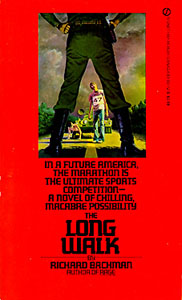
Book Review: The Long Walk
This is one of the few Richard Bachman books I'd actually read before I started my Stephen King chronology reading project, and I really liked it. It's not really like a normal Stephen King book (which I guess is why it was published by Richard Bachman in the first place), but it was interesting and unique at the time.
The book takes place in a dystopian version of the United States. If it's the future, it's not mentioned, other than the fact that a character makes reference to there being 51 states and someone else corrects him, saying it's "regions." Anyway, the all-powerful ruler of this land is a militaristic man known only as the Major, and one of the ways the Major exerts his control is via an annual contest called the Long Walk. Basically, it consists of 100 teenaged boys starting to walk in northern Maine until they can't walk anymore. If they stop walking, they get shot. If they try to walk off the path or road, they get shot. If they run toward the crowd of onlookers, they get shot. Eventually, there is only one walker left, and he is showered with money and whatever his heart desires.
Sound familiar? Like a certain trilogy with movie starring a certain actress I may or may not have a crush on? Yes, there are a lot of Hunger Games comparisons to be made - teenagers fighting to the death for the entertainment of the masses, etc. - although the general theme is a bit different. The boys in the Long Walk are volunteers, driven by the prizes or pride or youthful arrogance or, in the case of many, nothing really at all. Much of the book takes place on the Walk, and you see the change in the characters. They get thoughtful and introspective. They realize that death is all around them and that they, too, are capable of dying. They also start breaking mentally and physically, with just as many boys succumbing to insanity as physical ailments.
The story focuses on Ray Garraty, a 16-year-old from Maine. Garraty's father disappeared when he was a kid because he spoke against the Major, but that's not really why he's walking. He's not sure why he's walking, but he is. He befriends a handful of other boys, particularly the mature McVries, and is fascinated by Stebbins, a loner who doesn't seem affected by the physical and mental punishment.
The longer they walk, the more they open up to each other and the more boys fall. Who will be the last boy standing?
This book is incredibly dark and there are a lot of comparisons to be made to Rage, which is funny because I really didn't like Rage and I actually did like The Long Walk. The characters are almost all teenagers, and all of them have dark secrets that will eventually be revealed. The entire book takes place in one place - in Rage, it was a classroom; in The Long Walk, it's the Walk's endless path - and much of the plot is conversation. Both have an undertone of hatred for The Man, whether that Man is a militaristic dictator or a high school principal.
The difference, for me, is the stakes of the two plotlines. Charlie Decker murders teachers and holds his classmates at gunpoint because he doesn't know what else to do and he's crazy and suicidal. Ray Garraty and the other Walkers could also be crazy and suicidal, but I don't think so. I think they're young and immature and don't realize what they're getting into (at one point, after the first couple of boys are killed, Garraty admits to himself that he somehow thought the guns would be fake, with flags that said BANG! coming out instead of bullets). Plus, the Major is a real villain, unlike a high school principal or guidance counselor, and so it's easier to sympathize with and root for Garraty and his friends.
Wednesday, May 29, 2013
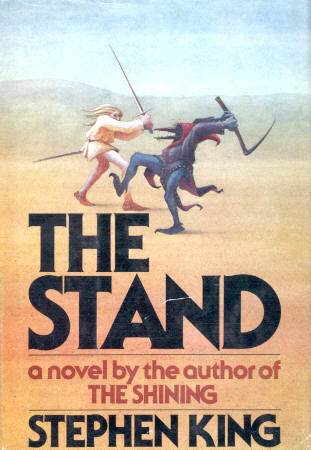
Book Review: The Stand
I would love to tell you that I have a fabulous excuse for not writing anything in a month, and in a way, I do. I mean, I have just been gestating a child for that time. Sure, that has required zero actual effort from me, save for doctor's appointments, but it does require naps. And extra eating. And by God, if it's for the good of the child, who am I to say no?
The other big excuse for not writing any book reviews in that time is because I haven't actually finished any books. Such is the fun of embarking on the journey that is The Stand, all 1,200 pages of it.
But without further ado, the great return.
The Stand
For those who somehow missed the last few decades, The Stand is Stephen King's epic tome about the fall and rise and fall and rise again of humanity. You could really break it into a few different sub-books (which is exactly what the 1994 miniseries starring Gary Sinise and Rob Lowe did over four nights), but here is as succinct a summary as I can give you: The U.S. government inadvertently releases a superflu meant for biological warfare. The flu, designed to act like the flu right up until the moment the patient dies, does its job and over the course of a few weeks one spring/early summer, kills more than 99% of the population.
What's left is a ragtag group of people who, for some reason, find themselves immune. We watch the downfall of civilization while learning their stories: there's Stu, a quiet factory worker from a small town in Texas; Frannie, a young co-ed who just discovered that she's pregnant by her ex-boyfriend; Larry, a one-hit wonder rock star hiding out from drug dealers at his mom's house; Nick, a young deaf-mute drifter; Lloyd, a small-time criminal who finds himself abandoned in a maximum security prison with no one to free him; the Trashcan Man, a pyromaniac; and more. Once everyone they know and care about dies, everyone starts to realize they're having the same dreams: about a sweet elderly woman named Mother Abagail in Nebraska and about a dark, evil man named Randall Flagg in Las Vegas. The "good" people, the ones chosen by God (including Stu, Fran, Nick and Larry) go to Mother Abagail; the "bad" (Lloyd, Trash) to Flagg.
Along the way, they meet up with people good and bad. Frannie travels with a teenage loser from her neighborhood named Harold who not-so-secretly pines for her. Stu makes friends with an old sociology professor named Glen. Larry befriends Nadine, a mysterious and guarded woman, and Joe, a young boy turned savage from PTSD. Nick becomes close with Tom, a mentally disabled guy, and Ralph, a country boy.
Anyway, the various groups go to their respective destinations and start to re-create societies there. Things quickly get bureaucratic with Team Mother Abagail until an internal attack leaves a few people dead and makes everyone realize that, oh yeah, there's a war about to start. God, through Mother Abagail, picks four people to walk to Las Vegas and confront Flagg, the "stand" referred to in the title.
This book is, by far, my favorite Stephen King book. It never ceases to impress me how he's able to develop his story so gradually and yet keep it interesting (Glen's ramblings about the dangers of society notwithstanding); he's also able to create dozens of characters, each unique and with their own characteristics. In a lot of King's books, you can easily pick out who kind of represents him, good or bad: Ben in 'Salem's Lot; Jack in The Shining. You can see parts of these King archetypes in some of the characters: Stu's sense of heroism that arises when needed; Nick's quiet intelligence; Harold's identity as a writer; Larry's overcoming his own personal demons to become a better person. But they are their own characters, and the others are fully developed, as well. And each continues to develop as the story goes on, allowing the changes in temperament or character that they display is obvious. Is the Harold that finishes the story the same that started it? Not by a long shot. The same could be said for any of them.
I read this as part of my (and by "my," I mean stolen from the Guardian) Stephen King chronology project, although I must admit, I did cheat and read the uncut rerelease version that came out in the 1980s. I mean, if you're going to read something, you might as well go whole-hog. It remains my favorite and I can't imagine that will change. Now I can look forward to watching that 1994 miniseries (the first DVD I ever purchased) and even awaiting the feature version (although that project sounds like it might be kaput).
Either way, if you never read another Stephen King book, or if you're the type to say you don't read Stephen King because you don't like monsters/gore/violence/etc., this is the one to read. There is a devil, and he is a villain, but the real danger, the real "bad guy" lives within all of the human characters - good and evil. The government officials who created this terrible disease; the doctors who abused Stu when they couldn't figure out what made him immune; the good people who make bad decisions out of jealousy or misplaced loyalty or pride. There isn't a murderous clown or a rabid dog or a hotel full of ghosts to do us in; we do a fine job all by ourselves.
The other big excuse for not writing any book reviews in that time is because I haven't actually finished any books. Such is the fun of embarking on the journey that is The Stand, all 1,200 pages of it.
But without further ado, the great return.
The Stand
For those who somehow missed the last few decades, The Stand is Stephen King's epic tome about the fall and rise and fall and rise again of humanity. You could really break it into a few different sub-books (which is exactly what the 1994 miniseries starring Gary Sinise and Rob Lowe did over four nights), but here is as succinct a summary as I can give you: The U.S. government inadvertently releases a superflu meant for biological warfare. The flu, designed to act like the flu right up until the moment the patient dies, does its job and over the course of a few weeks one spring/early summer, kills more than 99% of the population.
What's left is a ragtag group of people who, for some reason, find themselves immune. We watch the downfall of civilization while learning their stories: there's Stu, a quiet factory worker from a small town in Texas; Frannie, a young co-ed who just discovered that she's pregnant by her ex-boyfriend; Larry, a one-hit wonder rock star hiding out from drug dealers at his mom's house; Nick, a young deaf-mute drifter; Lloyd, a small-time criminal who finds himself abandoned in a maximum security prison with no one to free him; the Trashcan Man, a pyromaniac; and more. Once everyone they know and care about dies, everyone starts to realize they're having the same dreams: about a sweet elderly woman named Mother Abagail in Nebraska and about a dark, evil man named Randall Flagg in Las Vegas. The "good" people, the ones chosen by God (including Stu, Fran, Nick and Larry) go to Mother Abagail; the "bad" (Lloyd, Trash) to Flagg.
Along the way, they meet up with people good and bad. Frannie travels with a teenage loser from her neighborhood named Harold who not-so-secretly pines for her. Stu makes friends with an old sociology professor named Glen. Larry befriends Nadine, a mysterious and guarded woman, and Joe, a young boy turned savage from PTSD. Nick becomes close with Tom, a mentally disabled guy, and Ralph, a country boy.
Anyway, the various groups go to their respective destinations and start to re-create societies there. Things quickly get bureaucratic with Team Mother Abagail until an internal attack leaves a few people dead and makes everyone realize that, oh yeah, there's a war about to start. God, through Mother Abagail, picks four people to walk to Las Vegas and confront Flagg, the "stand" referred to in the title.
This book is, by far, my favorite Stephen King book. It never ceases to impress me how he's able to develop his story so gradually and yet keep it interesting (Glen's ramblings about the dangers of society notwithstanding); he's also able to create dozens of characters, each unique and with their own characteristics. In a lot of King's books, you can easily pick out who kind of represents him, good or bad: Ben in 'Salem's Lot; Jack in The Shining. You can see parts of these King archetypes in some of the characters: Stu's sense of heroism that arises when needed; Nick's quiet intelligence; Harold's identity as a writer; Larry's overcoming his own personal demons to become a better person. But they are their own characters, and the others are fully developed, as well. And each continues to develop as the story goes on, allowing the changes in temperament or character that they display is obvious. Is the Harold that finishes the story the same that started it? Not by a long shot. The same could be said for any of them.
I read this as part of my (and by "my," I mean stolen from the Guardian) Stephen King chronology project, although I must admit, I did cheat and read the uncut rerelease version that came out in the 1980s. I mean, if you're going to read something, you might as well go whole-hog. It remains my favorite and I can't imagine that will change. Now I can look forward to watching that 1994 miniseries (the first DVD I ever purchased) and even awaiting the feature version (although that project sounds like it might be kaput).
Either way, if you never read another Stephen King book, or if you're the type to say you don't read Stephen King because you don't like monsters/gore/violence/etc., this is the one to read. There is a devil, and he is a villain, but the real danger, the real "bad guy" lives within all of the human characters - good and evil. The government officials who created this terrible disease; the doctors who abused Stu when they couldn't figure out what made him immune; the good people who make bad decisions out of jealousy or misplaced loyalty or pride. There isn't a murderous clown or a rabid dog or a hotel full of ghosts to do us in; we do a fine job all by ourselves.
Tuesday, April 2, 2013
Book Review: This Is How You Lose Her
Talking about This is How You Lose Her has to begin with The Brief Wondrous Life of Oscar Wao. While that book depicts the life of Oscar and his family, it is told by Yunior, Oscar's friend and his sister's ex-boyfriend. Yunior has a fantastic story-telling voice, a conversational Spanglish that is both funny and poignant.
This is How You Lose Her is for Yunior. It is a collection of short stories about lost love. Almost all of them are from Yunior's perspective, and most of them are about relationships that he ruined. There is the adult neighbor he slept with as a teenager until he grew up and moved on; the sex-crazed Alma; the girl he broke up with after she told him she loved him. There are also stories about Yunior's father and older brother, who had similar histories of philandering and womanizing.
In the end, there are two big themes to the stories. One is the importance of family. A couple of the stories were brotherly love stories masquerading as relationship stories. His brother died of cancer, but not before sleeping around with a few different women and getting taken for a ride himself. The other, more important theme was understanding how Yunior has to change in order to be truly happy.
The last story in the book is called "The Cheater's Guide to Love" and it depicts the five years of Yunior's life after his fiancee discovers he's cheated on her with 50 women while they were together and leaves him. Yunior, who has a history of losing women because of his ceaseless cheating, nevertheless goes through a real mourning period. His subsequent relationships and experiences and the relationship mistakes he sees his friends committing have him realize that whatever it was that made him think sleeping around was OK - his belief that it's something all Dominican men are born with, the examples set by his father and brother and friends, his sexual development at the hands of his adult neighbor - is wrong and is causing him ultimate sadness.
A lot of people think Junot Diaz and Yunior are sexist and misogynistic. I think the opposite. I think they realize that whether this is a cultural thing or a familial thing or a hereditary thing or just a personal problem, it is a problem nonetheless. Some men and women think that by sleeping around, they are making themselves happy, but in the end, finding that one true love and holding on to him or her is what causes true happiness. I think that's a lesson Yunior learned too late, but he learned it nonetheless.
I liked this book a lot. A few of the stories, taken alone, seemed a little pointless or repetitive, but when read as part of the collection, it really develops Yunior's relationship history. The only story that didn't seem to fit was "Otravida, Otravez," about a young female Dominican immigrant who has a relationship with an older Dominican man (who has a wife and family back in the DR). None of the characters were tied to Yunior in any way that I could tell, although it did continue the trend of "Dominican men cheat." Still, it seemed a bit out of place.
Other than that, I enjoyed it and would read pretty much anything Junot Diaz put in front of me. And if I wasn't sure I liked him before, he was fabulous on the Colbert Report.
Sunday, March 10, 2013
Book Review: The Art of Racing in the Rain
The Art of Racing in the Rain tells the story of the Swift family through the eyes of their dog, Enzo. Enzo is a special dog - smart, intuitive, a true human brain in a canine body. If only he had opposable thumbs. Enzo was adopted as a puppy by Denny, then a young, single guy trying to climb the ranks to become a racecar driver. The two immediately fell for each other and Denny shared his love of racing by watching recordings of old races together and teaching Enzo his specialty: how to race in wet weather.
Years pass and Denny meets and falls in love with Eve. Enzo's not sure about Eve at first, but after a few emotional moments between the pair, they bond. When Eve gives birth to their daughter Zoe, Denny is on the road racing and it's Enzo who stays with Eve to comfort her through the night.
Eve soon becomes ill, and because she waits so long to go to the doctor, her cancer is fairly advanced. She doesn't have much time, so she moves in with her retired parents, who can care for her full-time while Denny works. She also takes Zoe with her, knowing she probably doesn't have much time left with her daughter. The whole situation makes sense except when Eve dies and her parents, citing the fact that they've cared for their granddaughter for the previous several months, sue Denny for custody. Everything is further complicated when Denny is simultaneously taken to court by one of Eve's manipulative cousins for a phony sexual assault charge.
The whole story is told from Enzo's point of view, and as I read the book and explained it to people, I could feel them rolling their eyes at the inevitable corniness of the situation. I understand. It sounds like it really should be corny. But Garth Stein does a fabulous job of giving Enzo a real voice: he is intelligent enough to be able to tell the story thoroughly but still enough of a dog that that part of his personality shines through (my favorite was when friends of Denny's dog-sit and Enzo becomes extremely embarrassed that they should discover he sleeps with a stuffed dog...but not embarrassed enough where he could sleep without the dog for the night).
In fact, Enzo's voice is probably the least corny thing about the book, which was pretty predictable and its human characters pretty one-dimensional. The real key to the book was the relationship between Denny and Enzo, and any person who has loved a dog would certainly understand the connection. In fact, everything considered, I would say that the book is actually extremely well-written, in a kind of strange way, because of the character of Enzo, not despite of him.
Saturday, February 2, 2013
Book Review: The Brief Wondrous Life of Oscar Wao
Oscar Wao is a young man growing up in Paterson, N.J. (home of Giants wunderkind receiver Victor Cruz). A first-generation U.S. citizen, along with his sister, his extreme nerdiness sets him apart from his cursed ancestors from the Dominican Republic. His maternal grandparents and his mother all ran on the wrong side of Rafael Trujillo, the horrendous dictator who ruled the DR from 1930 to 1952. While the previous two generations (and his older sister) all struggled with love and sex in ways that risked their lives and well-being, Oscar is more sheltered, an overweight comic book fanboy who regularly falls in love with girls who don't recognize his existence.
Still, Oscar is tragic in his own way. While he wasn't imprisoned until he lost his mind like his grandfather or burnt with scalding oil like his mother, he was a hopeless romantic, something that caused him great pain throughout his life and was the reason why that wondrous life was so brief.
While the story was an interesting one, I think the way it was told made it that much better. Most of the book is narrated by a third party - not Oscar or his mother or his sister - whose identity you learn about halfway through. In addition to learning about the history of the de Leon family, you also get a crash course in the history of the Dominican Republic, something I knew next to nothing about. And for a book with such serious topics - love, sex, death, rape, depression, desperation - the tone is actually kind of hilarious. Almost all of the DR historical information is relegated to long, opinionated footnotes. The narration is a strange conglomeration of Spanglish with random comic books, movies, sci-fi and fantasy stories referenced throughout.
The Brief Wondrous Life of Oscar Wao was the latest selection for the Snooty Book Club, with its Pulitzer Prize giving it instant credibility. I loved this book, and one of the reasons I did so was because it didn't resort to pretentiousness despite winning so many literary awards. It didn't trip over itself trying to sell its symbolism and Deep Meanings; it had all that stuff but still found a way to be funny and engaging. Despite the fact that it's been 10 years since I took high school Spanish, and therefore, I didn't understand some of the words or phrases, I still found it an extremely easy read that I blew through in a matter of days. I'm interested in checking out This is How You Lose Her, Junot Diaz' collection of short stories that all involve the narrator of Oscar Wao. Despite his straying eyes, I'm a big Yunior fan.
Thursday, December 27, 2012
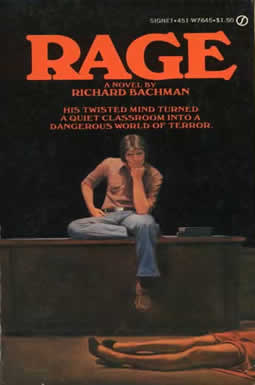
Book Review: Rage
I've been a Stephen King fan ever since I watched The Stand miniseries on TV when I was in the fourth grade. Like, a freaky fan. When I was in the eighth grade, I did a book report on The Tommyknockers. I am a sick, sad individual and I love me some Stephen King.
This year has kind of been the Year of the King for me. In addition to one of his best books ever coming out (11/22/63), I got a Stephen King bobblehead at Stephen King bobblehead night with the Lowell Spinners and I saw his speak at UMass Lowell earlier this month. This is a year after we went to Colorado on vacation and took a tour of the Stanley Hotel in Estes Park - aka the hotel on which the Overlook Hotel from The Shining is based and the one where the miniseries version of the novel was filmed.
Anyway, a few months ago, I came across a series by James Smythe at the Guardian, a fellow Kingophile who pledged to re-read every book chronologically. Frankly, I loved the idea. It appeals to both my love of Stephen King books and my obsessive-compulsive nature. Reading stuff I like AND doing so in a neat and orderly fashion. YES PLEASE. Plus I'll be able to read the things I missed over the years like, oh I don't know, the entire Dark Tower series.
I've been doing this for a few months now. I'm not as intense as Smythe, who is finishing them in a week. I have a full-time job that does not pay me to do this, plus I'm part of a book club which means reading other books plus - yeesh, book a week? By Stephen King? Good lord, there aren't enough hours in the day. But I'm plugging along and I just finished the fourth book.
The first three books in this project are standard King fare: Carrie, 'Salem's Lot and The Shining are all classics and ones I've read before. But the fourth is the first of the Richard Bachman series and the first book I've never read: Rage.
For those who don't know, Rage is about a teenage boy who takes a gun, kills two teachers and holds a classroom of students hostage for several hours. It is a dark book. There isn't telekinesis or vampires or ghosts to blame anything on; this is just a very sick and twisted boy. The book turns into a perverted Breakfast Club with Charlie Decker (the protagonist) and his hostages sharing traumas and embarrassments from their youth, embracing each other's struggles with abusive parents, confusing sexuality and issues related to popularity. Everyone eventually sympathizes with Charlie except for one boy who gets attacked by his fellow hostages and put into a catatonic state for his troubles.
This book is dark, as is the case with most of the Bachman books. But I was right in the middle of reading this book when the Newtown shootings happened, and the whole thing made me sick. Apparently, after this book came out in 1977, it had a couple of connections to real shootings. This freaked out Stephen King, who fought to have the book taken out of print and he won. I was only able to buy the book as part of an anthology with three other Bachman books.
I'm biased when it comes to anything penned by Stephen King but I have to say: I didn't like this book. It wasn't just the subject matter and the disturbing time I chose to read it, although that did affect me. No, it just felt like there wasn't a point to the matter. Rather than using this situation as a means to prove something else - the stupidity of high school cliques a la The Breakfast Club, the idea that everyone has had something crappy happen to them and we all have that in common, etc. - it just felt like this was a bunch of things that happened. I guess it does say something about Stockholm syndrome, but still. Nobody was all that sympathetic - not Charlie, in a sick and twisted way, and not even Ted Jones, who does nothing wrong technically - and therefore, in the end, I didn't care if everyone lived or died or what happened.
I used to think that Richard Bachman was created because Stephen King had been writing too quickly and his publishers didn't want to put out that many books by the same person in such as short period of time, and I think that's still sort of true. But the Bachman books are also so different. In the forward to this story, King talks about how much darker Bachman is, how he goes to a different place in his mind to write these stories, almost as though they're being written by someone else who just happens to live in his head. I see that now. The writing style is King, but the stories aren't. They're darker and the monster that haunts the characters isn't a ghoul but a person - a horrifying part of themselves or of humanity. And those are the scariest monster of all.
Subscribe to:
Posts (Atom)