Showing posts with label nonfiction. Show all posts

Tuesday, July 8, 2014

Book Reviews: Kids, Kaling and Christine

I'd like to blame the fact that I was stuck reading the same books for six months on having a new baby that required so much attention and time. It isn't completely untrue; babies have this innate ability to recognize when you're relaxing/settling down to watch TV/going to bed. They wait until you get comfortable, sigh with relief and then....OHMYGOD, MY PACIFIER CAME OUT AND IF IT IS NOT BACK IN MY MOUTH IN ELEVEN SECONDS, YOU WILL FEEL MY WRATH.

So yes, a baby was part of the reason, but I think the more accurate reason is that I just had so much TV to catch up on. Shut up, I know. But when you finally get the baby to sleep and you have an hour until you should go to bed yourself and you're faced with a book you may or may not be totally into OR a completely mind-numbing but entertaining episode of Survivor...well, I think we know where I stand on that. Plus, two of the books I was reading with Matt and the other was one I just didn't love.

Those are my excuses. I'll stop now.

After struggling through those last few months, I've now finished three books in about three weeks. It seems strange to review them all in one shot, but now I'm on a roll and I'm about to go back in the hospital with my son so I'm sure I'll finish two more in about five days, so here we go.

Someone Could Get Hurt by Drew Magary

Source: barnesandnoble.com

I have been a big Drew Magary fan for several years, since I stumbled upon his weekly mailbags on Deadspin. A freelance writer, he's written for a ton of places, and he excels at providing a first-person narrative that is both well-written and extremely hilarious. (For an example of why I love Magary so much, here is a piece he wrote a couple years ago on his attempt to take the SATs as a 35-year-old.) This collection of essays about his own experiences parenting his three young children came out when I got pregnant and it seemed like the perfect marriage of one of my favorite writers and a topic that I was understandably interested in.

At first, that's exactly what it was. We saw Magary read from his book for our anniversary last year and it was great. Then I read the first chapter aloud to Matt while we were on the way to learn about one of Joey's complicated medical issues at an appointment in Boston. The first and last essays are about his youngest child, a boy born with an intestinal disorder that required emergency surgery and a month-long stay in the NICU. Let's just say it hit a little too close to home. We read a few of the essays, but then took a break until we were in a better mindset.

The rest of the book, to be fair, does not have the dire horribleness of the first and last sections. Most are simple snapshots of a life with young children: turning a trip to a grocery store into a race; the ordeal of taking kids absolutely anywhere; his own struggles with feeling inadequate when faced with disciplining his oldest. There's nothing out of the ordinary, but the way he tells it, the stories are fascinating and hilarious. (Also, his final essay about life while his son was in the NICU for 27 days hit the nail so much on the head, it was freakish.) I don't think someone would need to be a parent to enjoy it, although I think anyone who would enjoy it needs a good sense of humor and not to be easily offended.

Is Everyone Hanging Out Without Me? by Mindy Kaling

Source: crushable.com

This was one of those instances where I knew I'd like this book even before I started it. I find Mindy Kaling fantastic in pretty much every format, and enough people likened this book to Tina Fey's Bossypants that I was prepared. The comparisons are certainly understandable; both women are funny and fabulous, able to emit self-deprecation while showcasing the talent that got them the success they have today. But while you could picture Fey as the awkward band geek who is destined to show everyone up at the 10-year reunion, Kaling is more the drama geek who spends her free time binge-watching comedy sketch shows (which she did) in a room decorated with heart-shaped TigerBeat posters.

Kaling's book offers a little of everything - her childhood, the trajectory of her career (including the story behind her two-woman stage show about a fictionalized version of the relationship between Ben Affleck and Matt Damon, which I want more than anything to see live), and random things that pop into her head. She has an entire chapter of selfies from her phone, most taken as a way for her to check whether that zit that appeared six hours before a red-carpet award show was adequately covered with makeup (looks good to me, Mindy!).

Whether or not you'll like this book is completely based on how charming you find Mindy Kaling to be. I personally adore her and so I adore this book. But if you find her annoying or just don't like her, well, it will probably take you even longer than six months to finish.

Christine by Stephen King
Source: Jmj713 on Wikipedia

This was the continuation of my Stephen King chronology experiment, which is still going strong. I probably missed a couple of reviews for books I finished over the past year or so, and I do apologize for that, but be assured that I haven't cheated. I've gone through them all. The fact that I finished Christine is a testament to that.

In addition to all of the excuses listed above, one of the big ones that kept me stuck on Christine is the simple fact that it is one of my least favorite Stephen King novels. It's funny to me that it is often one of the first stories listed when people talk about Stephen King's anthology, although I think it's because its plot is something that can be described in a handful of words. Carrie was the one about the telekinetic girl; The Shining was a haunted hotel; 'Salem's Lot was vampires; and Christine was the possessed car. But it's just not King at his best.

For those that aren't aware, Christine is a 1958 Plymouth Fury originally owned by a slug named Rollie LeBay and eventually purchased as a scrapheap 20 years later by Arnie Cunningham. Arnie is your typical high school nerd - glasses, acne, V-card still in tact. His only friend is Dennis Guilder, a decent-looking football player who dates cheerleaders. Dennis isn't EXACTLY the big man on campus, but he does pretty well for himself. Against Dennis' advice, Arnie is drawn to spend way too much for Christine and it quickly turns his life around: he alienates the parents to whom he had spent a lifetime being subservient; he clears up his acne and gives him enough confidence to start dating the new, beautiful girl in school; it makes him crazy and paranoid so he then ruins that relationship. Oh, and the car seems to fix itself and go after anyone who goes against Arnie.

It's a fine story, but it's not to the King standard for writing. Most of the characters are one-dimensional: Arnie is the classic high school nerd; Dennis is the high school jock with a heart of gold; Leigh Cabot is the beautiful new girl in school; Rollie is the dirty old man. I'm not sure when King wrote the book, but the uselessness of Leigh hearkens back to one of my beefs with 'Salem's Lot, back when King seemed to have difficulty writing women characters that weren't boring. Perhaps even more baffling is the way in which the story is told. The first third is in first person, with Dennis serving as your narrator. But at the end of the act, Dennis is seriously injured in a football game and spends the whole second act in the hospital, and so the story is told via third person. Dennis returns as your narrator in the final third. It seems strange - why not just make the whole story in the third person? 

I'm not crapping on King at the moment. Stephen King at his worst is still 10x better than most writers at their best. But compared to The Stand, Needful Things and some of my other favorites, Christine is something that simply exists.

Monday, August 5, 2013

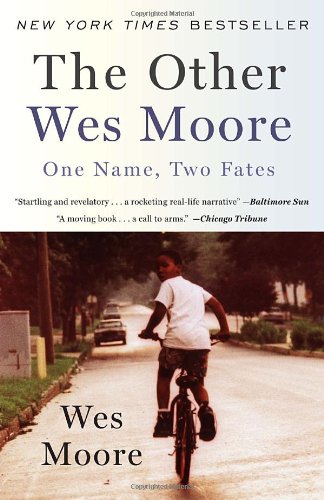
Book Review: The Other Wes Moore


Wes Moore was born in the late 1970s in one of the more poverty-stricken neighborhoods of Baltimore. After his loving father died of a rare and sudden illness when Wes was three, his mother Joy raised him and his two sisters herself. Joy was an immigrant from Jamaica, having arrived in the U.S. as a child so her father could get a college education. The importance of schooling was passed down as Joy also got her degree. But the struggle of raising three children alone wore on Joy and she moved them to the Bronx to get help from her parents.

Living in a tough neighborhood had its effects on Wes, who befriended people from all walks of life playing street basketball. Fearing of the dangers of the public schools she had attended herself, Joy sent Wes to a private school, but that only added to his troubles. At school, he stood out for being poor and black. At home, he stood out for going to a rich school for white kids. He started skipping classes and got caught up in minor street crime.

Seeing where Wes was headed, Joy and her parents scraped together the money to send him to Valley Forge military school in Georgia. Isolated from the streets, taken in by older cadets and supportive commanding officers, he rose through the ranks. He eventually went to Johns Hopkins University on scholarship, studied abroad in South Africa, earned a Rhodes Scholarship, worked on Wall Street, served in Afghanistan, and acted as a fellow at the White House.

Wes Moore was born in the late 1970s in one of the more poverty-stricken neighborhoods of Baltimore. After his father abandoned him before he was born, his mother Mary raised him and his older half-brother Tony by herself. Mary was one of nine children and had Tony as a teenager; she didn't have much support from her family and while she tried to go to college, she eventually had to drop out when government cuts took away her Pell Grant.

Living in a tough neighborhood had its effects on Wes, who befriended people thanks to his skills as a football player. Fearing the streets that turned her older son into a drug lord by the time he was in his early teens, Mary moved Wes around to different neighborhoods. Tony also wanted a different life for Wes, too, but the example he set was different than the lessons he tried to teach and Wes' criminal record began when he was just eight, after he brandished a knife at another boy in a street fight. Wes continued down Tony's path when he began working for drug dealers. He rose through the ranks, making money, friends, and enemies. He dropped out of high school, got his girlfriend pregnant and by the time he was in his early 20s, had four children by two women (one of whom was a drug addict) and several convictions for drugs and violence on his record.

 Seeing where he was headed, Wes tried to change his own path by participating in the Job Corps program, earning his GED and training as a carpenter. But a year of the legitimate life made he realize how much money it takes to support his mother, two former/current girlfriends and four children and he quickly regressed. One day, he, Tony and two other men wielding guns and mallets broke into a jewelry store and took almost $500,000 worth of merchandise. They also fatally shot an off-duty police officer.

Around the same time that one Wes Moore learned of his Rhodes Scholarship, the other Wes Moore learned that he'd spend the rest of his life in prison.

How could two men with the exact same name and such similar backgrounds have seen their paths diverge so drastically? There's no way to answer that and Wes Moore (the author) doesn't try to. The closest thing I can really see is the difference in support system. Yes, both men didn't have a father. But Joy had supportive family who cared about things like education and keeping Wes off the streets. When they recognized the warning signs that he might be headed down the wrong path, they did everything they could to stop it - first at the private school and then with military school. Mary didn't have those resources. She knew education was key but with no one to help her out, she could only do so much to support her sons. The other other "parent" that Wes Moore knew was his older brother, who became a player in the drug game at the ripe age of 14. When no one shows you another path, you take the one you recognize.

Still, it's a fascinating look at how our society works. The opportunities afforded to certain privileged people, whether it's because of race or class or geography, make things so much easier for some than for others. Wes Moore struggled to become the man he did, but he was given a leg up thanks to such a supportive family and, later, because of the connections he made at Valley Forge. The other Wes Moore, while he could have taken a different path, didn't really have the opportunity to do nearly as much as his namesake. This isn't to make excuses for the crime he committed - he definitely should spend his life in jail for killing an innocent man - but it's sad that that path was the easiest one for a boy to take.

Friday, July 12, 2013

Book Review: Gorgeous George: The Outrageous Bad Boy Wrestler Who Created American Pop Culture


I'm going to lose people right off the bat, thanks to the title and cover. And while, yes, this book is a biography of a professional wrestler, you don't have to like professional wrestling to be intrigued by the story of Gorgeous George. More than just serve as a fake pugilist, George did exactly what the subtitle suggests - he affected American pop culture in a way that is still being felt today (even if those performers don't even realize it). And by pop culture, I'm not talking about professional wrestling - I'm talking sports in general, music, TV, and the grand idea of "celebrity."

For those unfamiliar, Gorgeous George was a professional wrestler whose heyday came in the 1940s and 1950s. He was the ultimate "heel," wrestlespeak for "bad guy." He talked about how much better he was than not just his opponent, but the people of the crowd. How they were all dirty and poor and unattractive and beneath him. His "performance" began not when the bell sounded the start of a match, but before he even began walking to the ring: he would be preceded by a valet who would "disinfect" the ring with Chanel No. 10 perfume and then lay down a clean carpet on which his master could tread. Then, with the dulcet tones of "Pomp and Circumstance" ringing through the arena, Gorgeous George would begin walking to the ring. He would wear long, ornate, effeminate robes in bright colors; his hair would be bleached blonde and styled using gold bobby pins (which he called "Georgie pins.") He would rankle the audience members as they showered him with boos. When he got to the ring, his valet would help him disrobe and prepare for the match. The whole process took about 15 minutes; all the while, his opponent would be hanging out watching the show from his corner.

For more information about him, check out this video. You won't be disappointed.

To understand why George became such a phenomena, you have to look at that period of history. George first arrived as "Gorgeous," flaunting the luxury and expensiveness of his clothes and lifestyle, at the end of the Depression and then during World War II, a time when most people's funds were limited. He also arrived right around the time of television. This new medium of entertainment made professional wrestling extremely popular, as it didn't have to worry about paying writers or actors (unlike scripted TV shows); they could get away with using only one camera (unlike field sports like baseball or football); and because wrestling matches were predetermined, they didn't have to worry about one ending too soon to be worthwhile (unlike boxing). So wrestling was big, and as the biggest wrestler in the business, Gorgeous George was a household name for decades.

A handful of well-known celebrities directly credit George with their own personas. James "Godfather of Soul" Brown remembers watching him and adopting his fancy robes and outgoing ways. A chance meeting with George, after which George spent some time tutoring the then-teenager, Muhammad Ali's "I am the prettiest! I am the greatest!" routine is something that could have been taking word-for-word by a Gorgeous George interview. Even Bob Dylan - not exactly known for his flashy style - points to a meeting with George as what helped him figure out how to change his name and create a stage personality. The author of the book, John Capouya, does a good job of following those lines, those trends, down to the celebrities of today. Gorgeous George's influence is still felt.

In his personal life, while George did adopt his Gorgeous persona to the point where he legally changed his name to "Gorgeous George," he was not really the guy he portrayed on TV. For much of his career, he was a loving family man to his wife and two adopted children. Then he struggled with alcoholism and gambling and adultery, which cost him two marriages, two families, and all of his money, and when he died in 1963 of a heart attack brought on (probably) by his alcohol usage, he was destitute.

While the story of a famous person brought down by personal demons is not a new one, the story of Gorgeous George is utterly original, fitting of this breaking-ground man. It's also an exceptionally researched and well-written work by Capouya that would be easy for anyone - even the non-wrestling fan - to read and enjoy.

Wednesday, May 29, 2013

Book Review: Unfamiliar Fishes


The Snooty Book Club returned to the nonfiction genre this time around with Unfamiliar Fishes, Sarah Vowell's history of the annexation of Hawaii.

Before I read this book, I admittedly knew next to nothing about the history of Hawaii. My bad. It really is an interesting story that shows how people's interests and values have changed throughout history. What inadvertently kickstarts the acquisition of Hawaii by the United States is actually what unifies it in the first place - the bloody wars of Kamehameha the Great. If he didn't kill people who questioned his ways, he wouldn't have orphaned the boy who would become Henry Obookiah. If he wasn't orphaned, Obookiah, with nothing keeping him in Hawaii, wouldn't have hopped a merchant ship that eventually landed him in Connecticut. If he hadn't landed in Connecticut, he wouldn't have met the wannabe missionary seminary students. If he hadn't met them, the missionaries would never have thought to send people to Hawaii to spread the word of God.

As it was, Obookiah and his new missionary friends arrived in Hawaii in 1820, looking to tame those heathen beasts. In some ways, it's your typical story of American settlers moving west - they viewed Hawaiian customs and beliefs with condescension and tried to squelch it whenever possible. But it wasn't nearly as bad as Native Americans on the main continent. The missionaries wanted to change the natives mentally and spiritually, but never really forced them (unless you count getting close to the monarchs, who then forced them). They actually succeeded in educating the Hawaiians, teaching them and helping them develop a written version of their so-far-just-oral language so they could read the Bible.

What started as a change in customs, religion and beliefs became much more as the generations passed. Soon the settlers saw dollar signs, rather than potential crosses, in Hawaii, developing sugar plantations and even shipping in enough foreigners from other countries to make native Hawaiians the minority. When they realized the monarchs threatened their ability to own property and make money, they made steps to overthrow them and then get annexed by the United States for their valuable Naval ports.

That's the summary, but what makes Sarah Vowell books so interesting is the way she researches and writes them. Half the time, it reads like a tour book or an easy-to-understand history book; the other half of the time, it feels as though she's just another visitor in your tour group, making wisecracks about how some correspondence between Anglo-Saxon revolutionaries sounded like a Randy Newman song. She includes conversations with local experts and researchers, not using their thoughts and citing them in footnotes but actually transcribing conversations, which succeeds in tying these events from more than 100 years ago to today. Parts of it were difficult to understand - Vowell often focuses on describing an idea, rather than going chronologically, so it's hard to remember the context of some of the different events - and I would highly recommend reading the book as quickly as possible so you don't forget the names of the major players. Luckily, since the book is only about 230 pages long, that's not a difficult task.

Monday, January 21, 2013

Book Review: The Catcher Was a Spy


The Catcher Was a Spy is a biography of the fascinating, 20th century Renaissance man Moe Berg. Berg was as complicated as they come: Ivy League-educated but not terribly fond of working, a professional athlete known for his intelligence and bookishness, a spy who both pleased and frustrated his handlers.

Berg's life really comes in three parts. From his birth in 1902 until the end of his professional career in 1939, his life was baseball. He played as a child, was a standout shortstop at Princeton University, and was a professional catcher for more than 15 years. Most of those years he spent as a third-string backup, known more for his degree (in linguistics) and his reading habits (multiple newspapers every day) than his batting average. The famous quote was that Moe Berg could speak a dozen languages, but he couldn't hit in any of them.

At the start of World War II, Berg's second life began: as a spy for the United States Office of Strategic Services (OSS), a predecessor to the CIA. Berg's intellect and language abilities had him traversing throughout South America and Europe, and he was eventually given the important task of determining whether the Germans had developed a nuclear weapon.

Berg's third life, the 25 years that happened after the war, are far more complicated and confusing. As someone with his intelligence, background and pedigree, he could have been any number of things: a baseball coach, a professional spy, a lawyer, a college professor, even a reporter for one of those newspapers he held in such high regard. Instead he did...nothing. Legitimately, nothing. He bounced from acquaintance to acquaintance, accepting their gifts of room, board and food for days, weeks or even months at a time before moving on to the next friend. When there weren't friends around, he stayed with his brother or sister. And that's what he did, reliving the glory days, until he died in 1972.

I went into this book expecting to like Moe Berg. I'm a sports person, but I'm also a nerd and I always appreciate smart athletes who embrace their inner nerd. A baseball player, who was also a spy? Who was crazy smart but also loved sports? This guy had my name written all over him. But instead, I found him kind of infuriating. The last few years of his life were so wasted and for the simple reason that no job seemed good enough for him after his time as a spy. And after the OSS disbanded, he burned bridges at the CIA by spending their money lavishly on dinners and hotels and fine things in Europe and not keeping track of why any of it was necessary. So he just did nothing. The whole last 25 years of his life was telling and retelling and retelling stories from his first two lives: his success at Princeton, playing baseball with Babe Ruth in Japan, sneaking to the top of a hospital in Japan to get scene photographs (that he claimed helped the U.S. plan attacks on Japan during WWII).

Berg was clearly a complicated guy and the way Nicholas Dawidoff chose to tell the story is unique. He tells it as unbiased as possible - just the facts, thank you. But the final chapter questions just what made Berg tick. Was it his father, a Jewish immigrant from Ukraine who shunned his religion and wanted his children to be proud professionals? His two oldest paid attention: Sam was a doctor and Ethel gave up her love of entertaining to be a schoolteacher. But Moe stuck with baseball, which forever irked his dad.

Another theory was his discomfort at being Jewish. If he was unique in other ways (the smart baseball player, the baseball-playing spy), people wouldn't think of him as the token Jew.

Yet another theory was that he was so far in the closet, he didn't know what he wanted. Moe never married and the closest he got was a long relationship with a woman he kind of forgot about during WWII. Other than her, he claimed to fall in love with and propose to a couple of other women, which surprised them as they didn't even know they were dating Berg at the time. And then there are the stories of him getting a little too touchy-feely with underage girls. Some people claim Moe was very much gay, while others point out that he slept with several women. My favorite quote from this section is from the professional baseball player who said that Berg couldn't be gay, since he himself was alone with Berg many times, giving him ample opportunities, and he never ONCE hit on him. If that's the case, every single guy I went to high school and college with was gay. Amazing!

There are psychologists giving their theories about Berg but one thing is pretty obvious. He was one of those people who was so insecure - whether because of his father or his religion or his sexuality or a psychological condition - that he masked in a cloak of narcissism. It got worse as he got older and he would walk out of the room if someone asked him a question or tried to tell their own stories.

So, I didn't like Moe Berg as much as I thought I would. But I did like the book, which was incredibly well researched and written. It must have been difficult to look into the life of a guy like Berg, who was so open with certain stories but so closed in other ways. I'm glad Dawidoff did.